Board Meeting · Public Comment
Before We Build Again
Are we about to repeat the mistake we made building the elementary school?
A new high school is proposed for the Poplar Hill cluster — on the same Middle Tennessee karst where geothermal drilling has already caused documented, well-recorded damage. Before that decision is final, the public deserves to understand what's beneath the ground.
A decision is approaching — and the public has a window to be heard.
The school board holds a work session on Thursday, June 11 at 5:30 p.m., followed by its next regular board meeting on Monday, June 15 at 5:30 p.m. (RCS Central Office, 2240 Southpark Drive, Murfreesboro). Source: official RCS board meeting calendar. This is the window for residents and taxpayers to ask that the ground be properly studied before any drilling decision is locked in. Show up, write in, and ask the question below.
We're not asking you to stop the school. We're asking you to study the ground first.
This isn't about whether or where to build. It's about how — and specifically about one high-risk choice that can be made carefully or carelessly.
If the high school must be built on the proposed site, then the HVAC decision — whether to drill geothermal wells into karst bedrock — should be made advisedly, and only after thorough, rigorous, science-based site investigation appropriate to karst terrain.
Why HVAC?
A geothermal system requires drilling many deep wells into the bedrock. That drilling — not the building itself — is what disturbs karst and can trigger collapse. A different HVAC choice avoids it entirely.
Process, not outcome
We're asking for diligence, not a verdict: do the geophysical and geotechnical study first. Geothermal can stay on the table — but only if the science says the ground can take it.
It's already required
Tennessee guidance already calls for geophysical surveys by licensed professionals before construction in karst. The ask is simply that those standards be honored here.
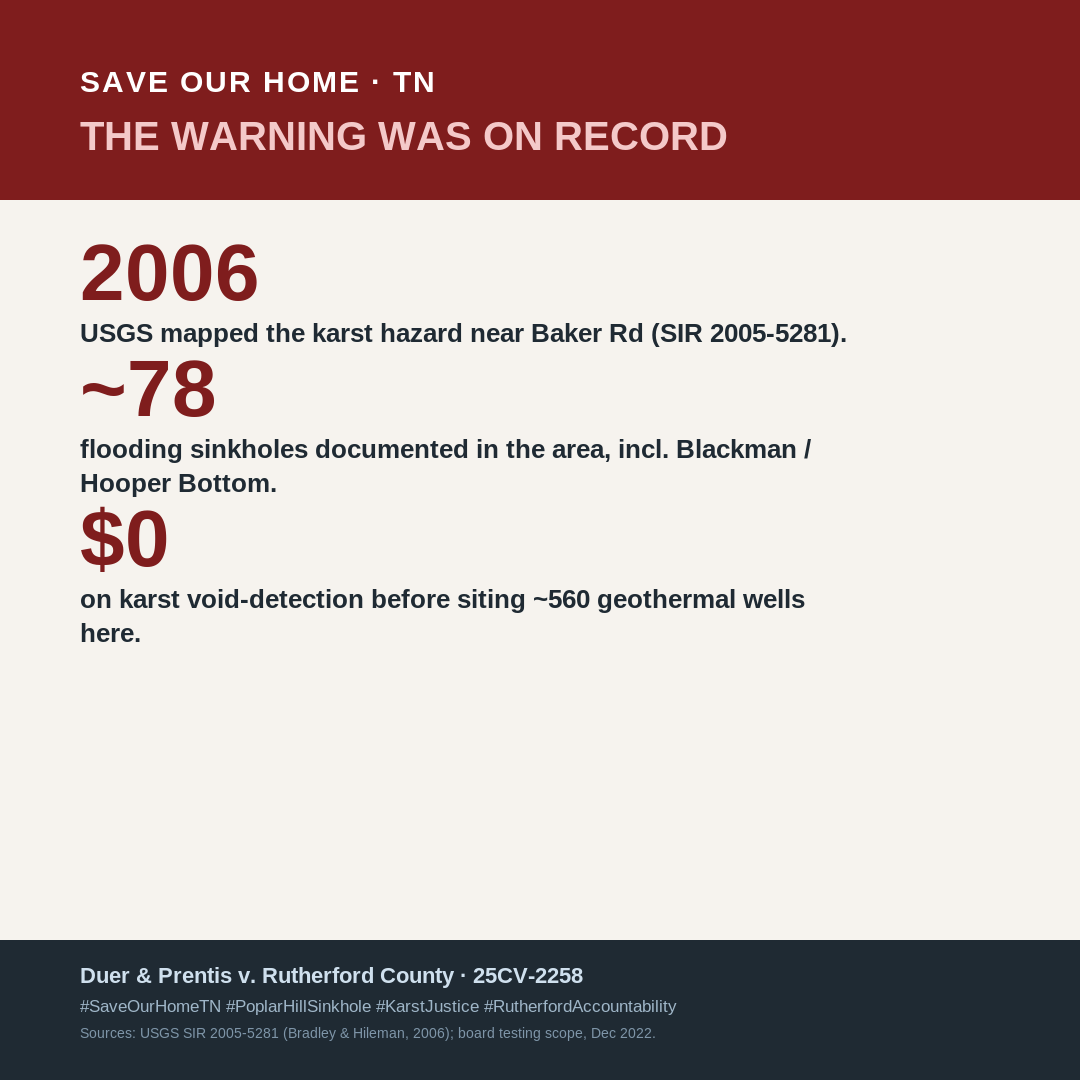
This already happened — one building ago, on the same ground.
When the Poplar Hill elementary school was built on Baker Road, the project drilled geothermal wells into karst limestone. The public record of what followed is the clearest reason to be careful this time.
These are matters of public and engineering record. A related lawsuit is ongoing; this page takes no position on its outcome and names no parties as a conclusion of fault — it presents the documented risk so the community can ask informed questions.
Why the ground beneath Middle Tennessee deserves caution
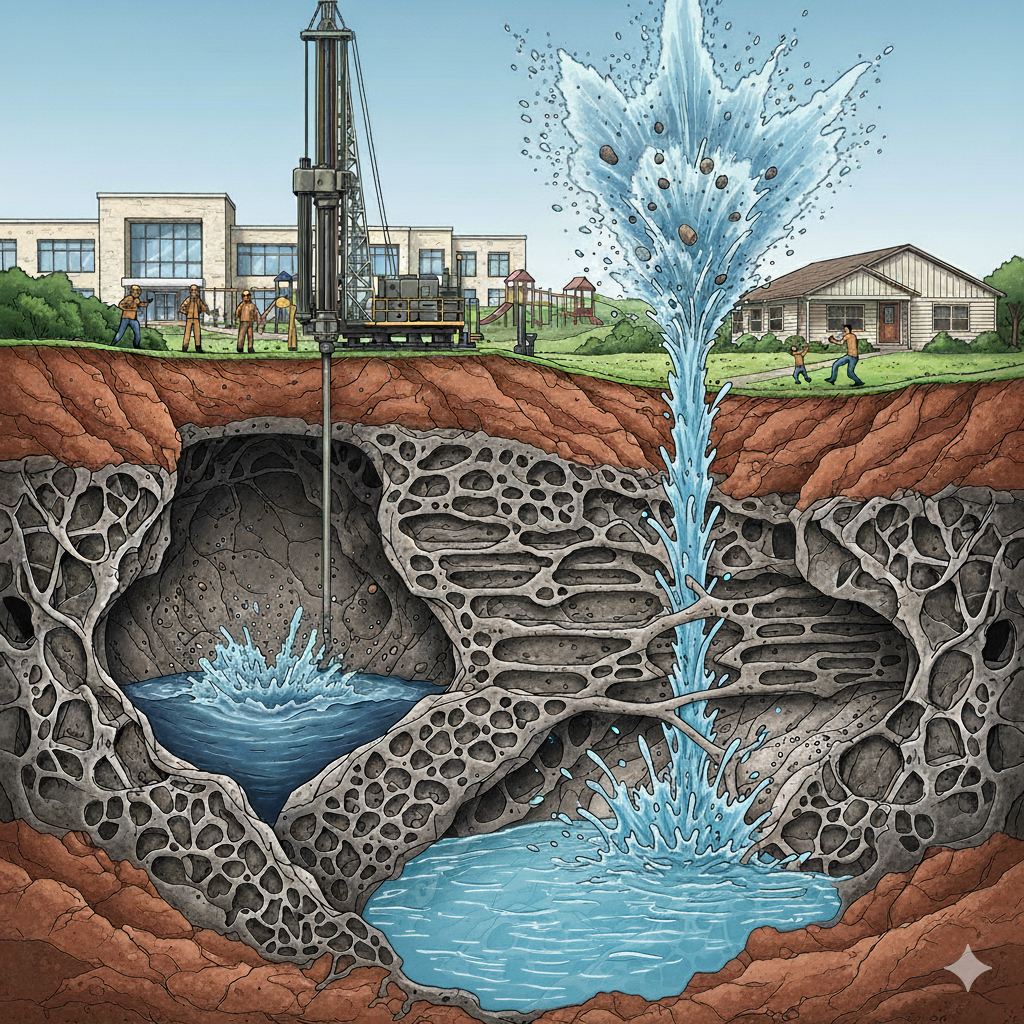
What is karst?
Karst forms where soluble bedrock — mostly limestone — is slowly dissolved by groundwater, leaving underground caves, channels, and voids. The surface can look perfectly stable while the rock beneath is riddled with cavities. Middle Tennessee sits on one of the largest karst regions in the United States; tens of thousands of sinkholes are documented across the state, and the great majority of counties contain at least one.
Why is drilling the danger?
In karst, the clay layer between the surface and bedrock acts as a structural bridge over voids. Drilling that disturbs this layer — or breaches the pressurized aquifer below — can fracture the clay, enlarge existing voids, and set off sinkhole formation. The hazard isn't the school; it's putting many deep holes into ground that is already hollow in places.
What rigorous, karst-appropriate investigation looks like
None of this is exotic. It's the recognized professional standard for building over karst — and the whole of our ask is that it be required, every time, before drilling.
- Geophysical survey by licensed geotechnical professionals to map subsurface voids before any drilling — as Tennessee karst guidance calls for.
- Site-specific geotechnical assessment of the actual parcel, not a generic regional assumption.
- Karst-feature mapping of sinkholes, depressions, and drainage on and around the site.
- An informed HVAC decision made after that evidence — choosing whether geothermal drilling is safe here, or whether another system avoids the risk.
- Modern drilling practice appropriate to fractured, water-bearing karst if drilling proceeds at all.
- A standing requirement, not a project-by-project judgment call — because the geology doesn't change between projects.
What is beneath the proposed site
The proposed school site (★) sits inside a field of documented water wells and karst sinkholes. Search your own street, toggle the layers, and see the proximity for yourself.
Interactive map opens on the site. It lists its own primary data sources — USGS (sinkholes/depressions) and TDEC (registered wells) — and links each well to its official report. The proposed-site marker (★) reflects publicly available map data; official parcel confirmation is in progress.
How to weigh in
Application to Speak at the June 15 Meeting
Show up
Attend the board's June 11 work session or the June 15 board meeting (both 5:30 p.m., RCS Central Office, 2240 Southpark Drive, Murfreesboro). Public comment at board meetings follows the district's public participation process — that's where reasonable questions become part of the record.
Ask the question
Ask the board, in writing or in person: "Will a rigorous, karst-appropriate site investigation be completed before any geothermal drilling is approved?"
Share what you learn
Send neighbors to this page. An informed public is the best protection against a costly mistake made quietly.
Spread the word · Comparte
An informed public is the best protection against a costly mistake made quietly. Share this page in one click.
Get a reminder before the meeting
Can't make it, or want a heads-up? Leave your email and we'll remind you before the June 11 and June 15 meetings — and tell you what happens next.
Prefer email? Write us at hello@beforewebuildagain.com
Building near the site — or anywhere on karst?
If you live in Middle Tennessee, you live on karst. Anyone planning to build any structure over karst should insist on the same diligence described above. If your property has shown new cracks, settling, or changes in water behavior, consider an assessment by a qualified geotechnical professional.
Resources & references
Scientific, regulatory, and professional organizations for karst geology and construction over karst.